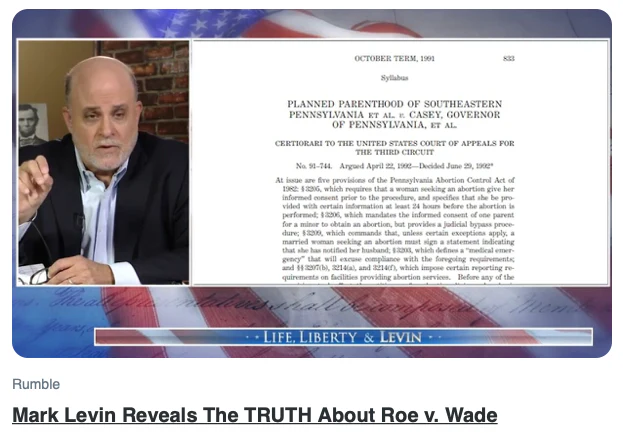
In this segment of Life, Liberty & Levin, Levin’s position is direct: the Supreme Court overstepped its constitutional role in both Roe v. Wade and Planned Parenthood v. Casey by effectively creating national abortion policy rather than interpreting the Constitution.
How He Supports That Claim
Levin points to the actual structure of the Casey decision—specifically the detailed rules around abortion procedures—to argue that the Court wasn’t simply recognizing a right. Instead, he says it was:
- Defining how that right operates in practice
- Setting standards like waiting periods and consent requirements
- Acting in a way that resembles legislation
His conclusion:
When the Court starts managing policy details, it has moved beyond interpretation into lawmaking.
His View of the Constitution
Levin’s position rests on a particular constitutional framework:
- The Constitution does not explicitly mention abortion
- Therefore, abortion policy should be decided by:
- state governments
- elected representatives
- Courts should not create rights that aren’t grounded in the text or original understanding of the Constitution
This aligns with a strict originalist view of constitutional interpretation.
How He Frames Dobbs
Levin presents the Dobbs v. Jackson Women’s Health Organization decision as a correction.
In his view, Dobbs:
- Reverses improper judicial decisions (Roe and Casey)
- Removes the Court from policymaking
- Returns authority to democratic institutions
He emphasizes that this doesn’t settle abortion policy nationally—it decentralizes it.
The Broader Point
Levin is not just arguing about abortion. He’s making a broader claim about government structure:
- Courts should interpret law, not create it
- Legislatures should make policy
- When courts expand their role, they undermine democratic accountability
Bottom line
Levin’s position can be distilled to this:
Roe and Casey represent judicial overreach, and Dobbs restores the proper constitutional balance by returning abortion policy decisions to elected lawmakers rather than unelected judges.